Saturday, July 12, 2014

Osprey

The baby osprey are getting close to fledging.  The house wrens are already well into their 2nd brood, but the osprey are just finishing their first.  It takes a lot more food to make a baby osprey!  There are three babies in this osprey nest, although one is significantly smaller than the rest.  You can see one of the babies on the left side of the nest in the pictures below.

Some larger bird species frequently lay one more egg than they can typically raise successfully.  This extra egg acts as an insurance policy.  Usually this baby is too small to compete with it's siblings.  However, if something happens to one of the larger babies, the parents still have a chance to reproduce.  If it's a particularly successful year, the parents can raise an extra baby!

 The male osprey comes in for a landing
One fledgling on the left, adult female in the middle, and adult male on the right

Friday, June 13, 2014

Welcome, Allie!

We're very happy to welcome Allie back to the wren project this summer!  Allie is an MSU zoology major Allie who was my URA during the summer of 2012 when I was first starting out.  Now she's back to do an independent project looking at female house wren song.  You can see her decked out in recording equipment below.  Female house wren songs show lots of variation between individuals.  Allie is trying to figure out what these songs might be communicating to rival females.  Stay tuned for more news on her project!

Allie is excited about recording females

Spectrogram of the song from the female rd/pu, or/al at 11.  Spectrograms are read sorta like music- notes higher on the y-axis are higher pitched.  Darker spots are louder.  11's song is reminiscent of the first song I ever recorded.

Tuesday, June 3, 2014

Disappearing Females

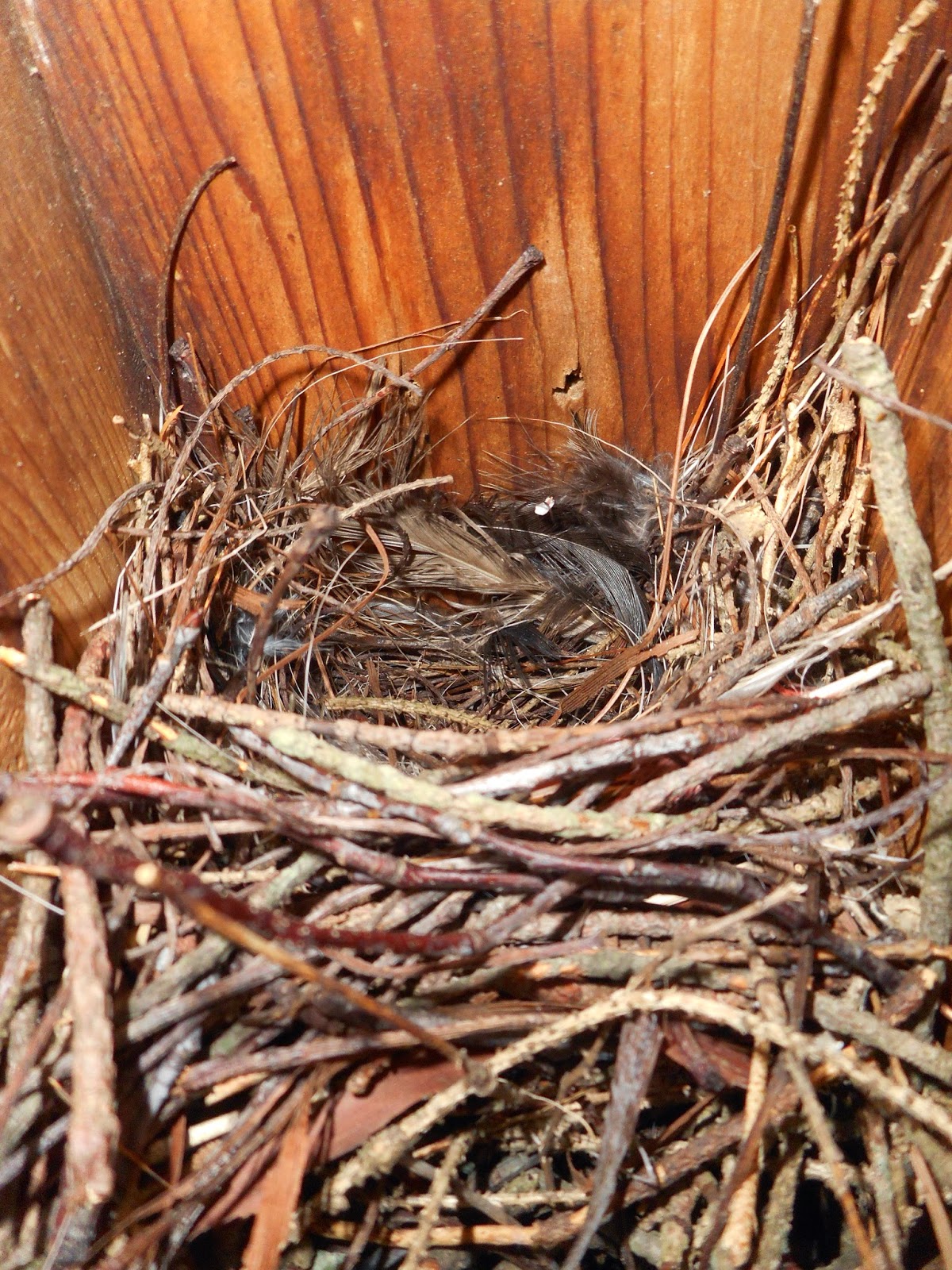
Bk/wh, gn/al's first attempt at polygyny was short-lived.  This morning all the eggs in his second nest were gone (perhaps illustrating the disadvantage of sharing a mate)!  You can see a picture of this nest below.  This is one of the frustrating cases where we're not sure exactly what happened.  Usually when a predator get's the eggs, they disturb the nest in some way.  This nest had some new sticks near the front and no evidence of the eggs either in the box or on the ground.  New sticks are usually a sign that either a new male has moved in or the male lost his female and resumed building.  I spotted bk/wh, gn/al on this territory today, but there was no sign of a female.  The next couple days could reveal what happened.  If there's a new egg or evidence of substantial female building tomorrow, this was likely a female replacement.  If there are no female signs tomorrow, it will remain a mystery.

Nest at A3.  Empty nest cup is at the back, new sticks are near the front.

Sunday, June 1, 2014

Polygynous Males

Today we confirmed that the first male to arrive (bk/wh, gn/al) has attracted a second female!  The house wren mating system is classified as "facultatively polygynous".  This means that most of the time they are socially monogamous, pairing with just one mate (though often mating with many more!).  However, given the opportunity male house wrens will attract a second female and become polygynous.  Usually this is fairly rare at my study site because of the way the boxes are placed.  This year several males are attempting polygyny, possibly because the population is still rather small.  Usually males attract females on adjacent territories, but bk/wh, gn/al actually has two territories separated by a large field.  You can get a sense of the distance in the picture below.

Bk/wh, gn/al's first territory (A6) is to the right of my car.  His second territory (A3) is against the treeline across the field at the left-most edge of the photo

This year is shaping up to be very successful for bk/wh, gn/al.  He's gone from building a crooked nest in 2011 and attracting zero females to pairing with two simultaneously this year.  Polygyny is great if males can manage it because they can potentially produce twice the offspring.  Polygyny is less great for females.  Males help protect nests from predators and other wrens, help signal when it's safe to leave the nest when the female is incubating, and feed the nestlings with the females.  When the male's attention is split, the females can suffer.  Bk/wh, gn/al's first female is currently half way through her incubation period, so she will be done with her clutch by the time the second female's eggs hatch.  This should decrease the negative effects of polygyny. 

Bk/wh, gn/al's age might have something to do with the fact that he's so successful this year.  Females might prefer older males because they've demonstrated the ability to survive that long and could pass those genes on to their offspring.  Male skills may also improve with age.  Bk/wh, gn/al's nest building skills certainly have!  Perhaps his skills at wooing females have as well.

Tuesday, May 27, 2014

Welcome, Aaron!

I'm very happy to welcome Aaron, my Undergraduate Research Assistant (URA), to the wren project this summer!  Aaron is a Fisheries and Wildlife major from Michigan State University.  Aaron will be helping me complete my experiments this summer, as well as conduct a small project of his own.  He's been here for almost two weeks now and is doing a great job!  This summer he'll be looking at egg coloration in house wrens.  Stay tuned for more news on his project!

Top: Aaron looking excited to be checking boxes
Bottom: Aaron holding the male from A4

Blood Parasites

If aggression helps female house wrens, why aren't all females highly aggressive?  This summer I'm looking for a cost to female aggression that might explain the variation I see in my population.  Last summer I thought that more aggressive females may have less time or energy to raise their offspring.  However, it turns out that aggressive moms actually have bigger, faster growing babies.  This summer I'm investigating whether aggression has an immune cost. 

In males of some bird species, the hormone testosterone that controls male aggression also depresses the immune system.  Males have balance between the reproductive benefits of aggressively defending territories and females and the costs to their overall health.  We don't know yet whether testosterone controls female house wren aggression or whether it negatively impacts health.

To get a measure of health, we are making blood smears to look for avian parasites.  To do this we take a small blood sample from the female's wing (which is very similar to when you get your blood drawn at the hospital).  Then we smear a few drops across a microscope slide.  When the stained slides are viewed under a microscope we should be able to see a variety of parasites in the blood, such as avian malaria.

Preparing a house wren wing for a blood sample

There are many different ways to measure immune function in wild birds, some more complicated than others.  We chose blood slides since they're relatively fast and easy when we're already taking blood sample.  It should also be fun to see the parasites under the microscope!

Slides box with house wren blood smears taken a few weeks ago.  It's more full now!  
Stained slides are in the background and unstained slides are in the foreground

Monday, May 26, 2014

Territory Wars

This summer is off to an interesting start.  The birds arrived a month ag,o but they spent quite a long time at the beginning of nesting before the first female was ready to lay her eggs.  This is possibly because the temperatures have been slightly lower than normal.

Possibly because of this late start, most sections of the field site are in a state of territorial unrest.  Both males and females are involved in these territory fights.  Two days ago we mist netted the male at B5.  After we caught the male, we played female playback to try and get the female.  We caught an intruding male instead!  It will be very interesting to get the genetic results back from the offspring to see whether the territorial male or the intruder fathered the egg she laid the next day.

At C5 two females have been having a week long fight.  The female initially banded there lost her territory for several days to an unbanded female that laid several eggs.  However, on the 4th egg laying day the old female had tossed all the eggs on the ground and reclaimed the territory.  How do we know a wren got the eggs?  Notice the tell-tale beak-sized punctures in the egg below.

Egg found on the ground in front of box C5 with several puncture wounds from a female wren beak.
 
 
For one of my experiments this summer, I'm kicking birds off territories to increase the number of floating birds that can challenge territory holders.  I'm hoping to determine whether females that are more aggressive in my tests are able to keep their territories longer.  Although I have only evicted 3 pairs so far, the birds seems to be doing a good job of this themselves.  I might also be getting a helping hand from the resident mammals.  Destruction of the box at B3 by a flying squirrel appears to have set off a chain reaction of territory switches in the B's and C's over the past week.  

   Massive mammal damage to the box at B3